
Why the best marketing leaders know it’s not either/or – it’s both.
For years, the marketing world has been split between two camps: the brand builders and the performance chasers.
One side obsesses over storytelling, emotion, and equity. The other is driven by numbers, clicks, and conversions.
In 2025, this divide is blurring fast, as companies demand agile, accountable marketing capacity and marketers aim to build long-term, purpose-driven careers, understanding how these two forces work together has become essential. At Augmint, we see this every day – companies seeking talent who can think strategically like a brand marketer and act tactically like a performance marketer. The future belongs to those who can do both.
The Fundamentals – Two Sides of the Same Coin
Brand Marketing: Building Meaning and Memory
Brand marketing is the long game.
It’s about shaping perceptions, crafting emotion, and anchoring your company in the customer’s heart and mind.
Think of it as investing in trust.
A great brand campaign may not trigger immediate sales, but it seeds recognition, credibility, and preference – the kind of invisible equity that compounds over time.
Core levers of brand marketing:
- Storytelling and emotion
- Purpose and positioning
- Creative consistency
- Distinctive identity (voice, tone, design)
- Long-term brand health metrics (awareness, recall, trust, preference)
Brand marketing builds the why – the reason a customer chooses you even when cheaper options exist.
Performance Marketing: Driving Action and Accountability
Performance marketing is the short game – data-driven, targeted, measurable.
It’s about generating immediate business outcomes – clicks, leads, purchases, downloads.
The goal is efficiency and scale, ensuring every rupee or dollar spent delivers trackable ROI.
Core levers of performance marketing:
- Paid media and digital ads
- SEO and SEM
- Conversion rate optimisation
- Retargeting and remarketing
- Attribution modelling and analytics
Performance marketing builds the how much – how much engagement, conversion, and revenue the brand generates.
Why the Conflict Exists
Many organisations make the mistake of separating these two disciplines too rigidly – or worse, pitting them against each other.
Brand teams talk about “emotion and equity.”
Performance teams talk about “data and ROI.”
The problem? Marketing today doesn’t live in silos.
Consumers don’t distinguish between your ad on Instagram, your store experience, or your product review on Amazon – it’s all the brand experience.
If your brand marketing isn’t inspiring your performance marketing, your campaigns will feel hollow.
If your performance marketing isn’t feeding insights back to your brand strategy, you’ll keep shouting louder without getting smarter.
The Modern Solution – The Performance Brand Loop
The best marketing organisations today integrate both disciplines into what we call the Performance Brand Loop – a system where brand meaning fuels performance efficiency, and performance data refines brand storytelling.
Here’s how it works:
- Brand marketing defines who we are and why we matter.
- Performance marketing tests how audiences respond and what drives action.
- The loop closes when performance data is used to sharpen brand positioning, while brand equity makes performance ads more effective.
It’s not “art versus science.” It’s art informed by science.
What This Means for Marketers
If you’re a marketer in 2025, your value no longer lies in choosing sides – it lies in bridging them.
The Augmint Talent Index (ATI) shows a clear trend: the most in-demand marketers today demonstrate dual fluency – creative empathy and analytical rigor.
To thrive, you need to develop:
- Strategic brand thinking: Understand customer psychology, positioning, and purpose.
- Analytical skill: Be comfortable with performance dashboards, funnel metrics, and attribution.
- Creative agility: Use insights to craft ideas that both inspire and convert.
- Business sense: Align brand building with commercial outcomes.
This blend of art and accountability defines the new generation of high-performance marketers.
What Companies Need to Do
For companies, the challenge isn’t just hiring more marketers – it’s building marketing capability that connects long-term brand health with short-term growth.
Here’s how forward-thinking organisations are doing it:
- Discover talent with both creative intuition and commercial judgment (not just tool knowledge).
- Develop them through continuous upskilling – brand craft, performance analytics, AI tools, and marketing leadership.
- Deploy them in integrated teams – where brand and performance marketers collaborate, not compete.
Metrics That Matter
It’s time to move beyond vanity metrics (likes, impressions, reach) and think in terms of combined outcomes:
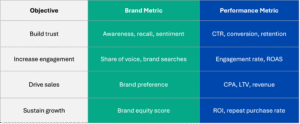
A mature marketing function tracks both – because awareness without conversion is wasteful, and conversion without trust is fragile.
The India Perspective
In India, where digital ecosystems are exploding and consumer trust is hard-earned, this balance is even more critical.
A well-told brand story creates differentiation in a crowded market.
But data-driven performance campaigns help reach Bharat’s diverse, multi-lingual audiences effectively.
The next wave of pre-vetted marketing talent emerging from India will be those who understand how to localise brand storytelling and optimise digital performance – equally well.
The Future: The Rise of the “Full-Stack Marketer”
Tomorrow’s marketing leaders won’t be “brand managers” or “performance specialists.”
They’ll be full-stack marketers – fluent in both strategy and execution, narrative and numbers.
They’ll use AI for insight, analytics for precision, creativity for impact, and empathy for connection.
We call them performance craftsmen – marketers who see marketing as a measurable, trainable, improvable craft.
Brand marketing makes people care.
Performance marketing makes them click.
But sustainable growth happens when the two work together – when creativity meets accountability, and meaning meets measurement.
The next time you plan your marketing strategy, ask not “brand or performance?”
Ask instead – how can our brand inspire performance, and how can performance reinforce our brand?
Because in 2025 and beyond, the winners won’t be those who pick sides – they’ll be those who build bridges.